
As of October 1, 2025, Poland has implemented a deposit return system for beverage containers in accordance with the EU SUP Directive, aimed at increasing recycling and reducing plastic waste. The introduction of this system brings significant changes to VAT accounting that every entrepreneur should understand and prepare for in their bookkeeping processes.
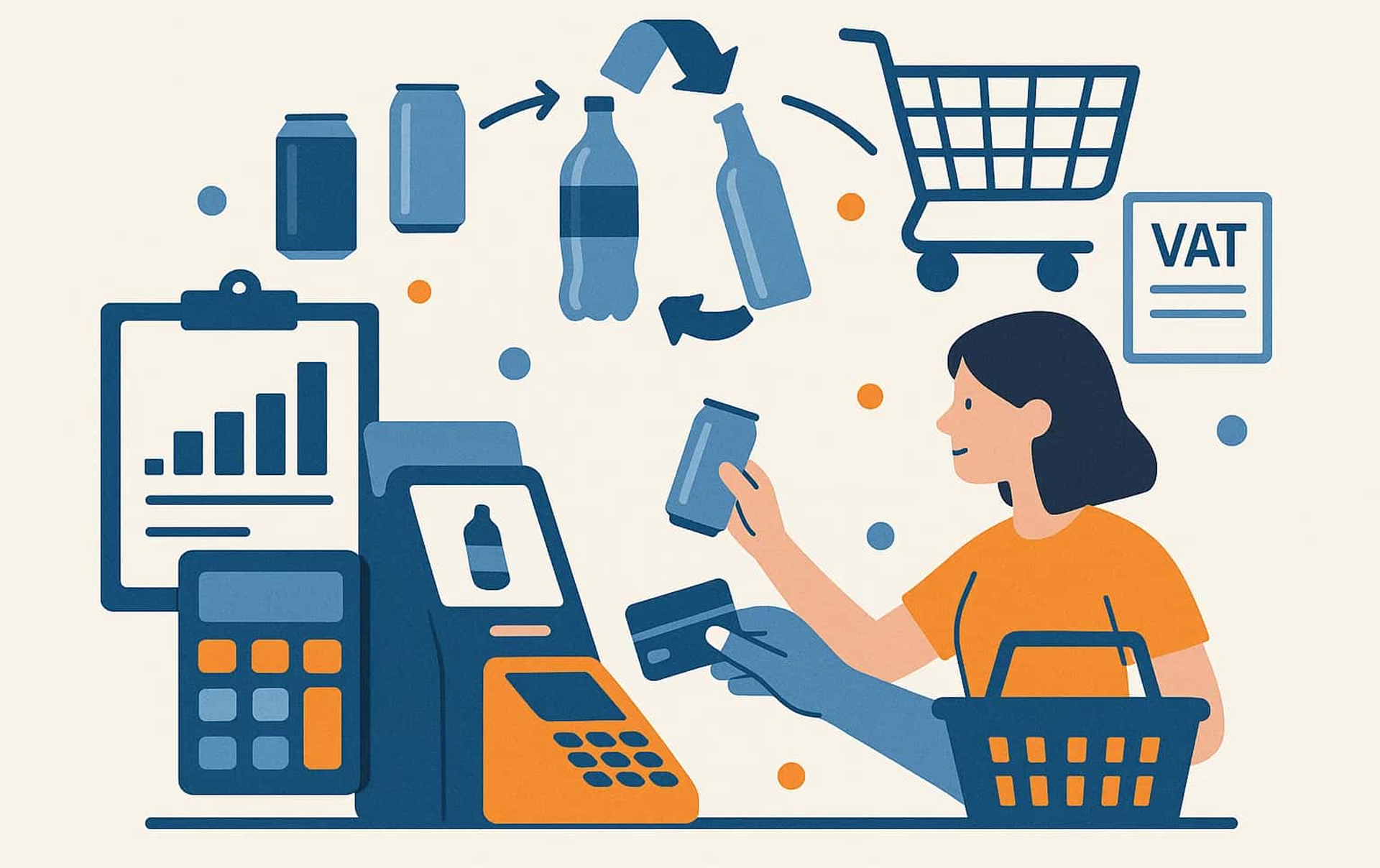
Impact of the Deposit Return System on Company VAT Settlements
Under the deposit return system, deposits charged for containers (both reusable and single-use) will be added to the product price at every stage of the supply chain—from the producer or importer, through wholesalers, to retail sellers.
The key change, however, is that according to the new regulations, the deposit will not be included in the VAT tax base at any stage of circulation, provided the container is returned by the consumer.
Obligations of Entrepreneurs in the Deposit Return System
- Retail sellers must accurately record collected and returned deposit amounts to properly account for VAT.
- Producers and importers will be required to charge VAT on the value of deposits for containers that were not returned by consumers in a given tax year. This means the need for accurate record-keeping and settlement at the end of the calendar year.
- Deposit system operators (managing returns and settlements) will have additional record-keeping and reporting obligations, which affects the overall transparency and control of the mechanism.
Who, What, How?
must join the deposit return system and maintain records of containers placed on the market along with charged deposits.
are required to accept returned containers without requiring a receipt and to refund deposits to consumers.
may limit returns (except for reusable glass bottles, which they must accept) and must enter into an agreement with the system operator.
must properly record and report data to the operator and authorities.
Deposit Records and Refunds vs. VAT
DEPOSIT RECORDS AND VAT SETTLEMENTS
Companies must implement systems that allow for distinguishing deposits from product prices in sales and purchase documentation. This ensures that VAT is charged only on the value of the beverage itself, not on the deposit (in case of container returns). Strict ongoing control of return status is necessary to correctly determine deposit amounts subject to annual taxation.
Consequences of Non-Return of Containers
Deposits for unreturned containers constitute taxable income and must be additionally reported in the annual VAT settlement. In practice, entrepreneurs must plan appropriate accounting procedures at year-end to settle these amounts and avoid errors and the risk of tax audits.
How to Account for a Deposit When the Container Is Not Returned?
When a consumer does not return the container, the deposit becomes the entrepreneur’s income and is subject to VAT. Regulations indicate that the value of this deposit should be reported and settled in VAT in the annual settlement for the given tax period, which requires systematic recording of container returns and associated deposit amounts.
Labeling and Informing Consumers
The introduction of the requirement to mark containers with the deposit system symbol and inform consumers about the deposit amount and return rules is also a new challenge for companies. Labels should appear both on containers and at points of sale or in product descriptions in e-commerce, which requires coordination with marketing and sales departments.
Obligations of Entrepreneurs in the Deposit Return System

Benefits and Challenges for Companies
The new system introduces a high degree of organization and clarity, particularly regarding the exclusion of deposits from the VAT base at every stage of the chain, which increases settlement transparency and improves companies’ cash flow. At the same time, the challenge remains the need for precise record-keeping of returned and non-returned containers to correctly calculate the VAT due.
Frequently Asked Questions
Additional Aspects Important for Entrepreneurs
1. Obligations of Commercial Entities of Different Sizes
Businesses selling beverages in containers subject to the deposit return system have different obligations depending on the size of the point of sale. Stores over 200 m² must accept returns of all containers covered by the system and pay deposits to consumers, while smaller points (under 200 m²) have the right to limit return obligations, except for reusable glass bottles, which they must accept. Smaller stores must, however, sign agreements with the system operator, which involves the need to record sales and charge deposits.
2. Obligation to Sign an Agreement with the Deposit System Operator
All entrepreneurs placing containers covered by the system on the market must enter into an agreement with the system operator selected through a competition by the Ministry of Climate and Environment. The operator is responsible for collection and management of container returns, which requires close cooperation from companies and data reporting in accordance with its guidelines to ensure proper VAT settlements and compliance with adaptation requirements.
3. Impact of the System on Waste Management and Product Prices
Companies should prepare not only for accounting and tax changes, but also for the need to invest in infrastructure (e.g., reverse vending machines) and staff training to operate the new system. This may impact increased operating costs, which may be partially passed on to consumers in the form of higher beverage prices.
4. Settlements for Online Sales
Companies conducting online sales are also subject to the deposit system obligation and must provide consumers with the ability to return containers, e.g., through partner points or return logistics. This means the need to organize additional logistics processes and integrate e-commerce systems with deposit recording and refund mechanisms.
5. Control and Penalties for Non-Compliance with Regulations
The new regulations provide for penalties for failure to fulfill obligations under the deposit return system, both regarding deposit recording and VAT settlements, as well as ensuring the possibility of container returns. Financial sanctions may affect producers, importers, and sellers, therefore accuracy in settlements and full compliance with regulations are crucial in managing tax risk.
Deposit Return System | VAT in JPK_V7
How to Report VAT on Unreturned Deposits in JPK_V7
VAT on unreturned deposits in the deposit return system is reported once a year, in the JPK_V7 declaration for the first settlement period of the year following the year in which the difference between introduced and returned containers arose.
For monthly taxpayers, this is usually the declaration for January (filed by February 25), and for quarterly taxpayers, the declaration for the first quarter (by April 25). Exceptionally, for 2025, this settlement will be filed in the declaration for February 2026.
In the JPK_V7 file, the increase in the tax base and VAT amount for unreturned deposits is reported in fields corresponding to the VAT rate assigned to the beverage (e.g., 23% VAT in fields P_15–P_20 and K_15–K_20).
A new feature is the special field P_360 (in the declaration section) and K_360 (in the record section), in which the total tax on unreturned deposits is reported. The document number name in the records should be entered as DEPOSIT RETURN SYSTEM, and in the contractor’s number and name, the details of the entity representing the party responsible for depositing the deposit into the bank account.
In practice, this means the need for separate recording of deposits and the VAT base, as well as proper inclusion in JPK_V7 according to the assigned rate (e.g., 23%). The entity representing the deposit return system acts as the VAT payer and it is this entity that declares and pays this tax to the tax office.
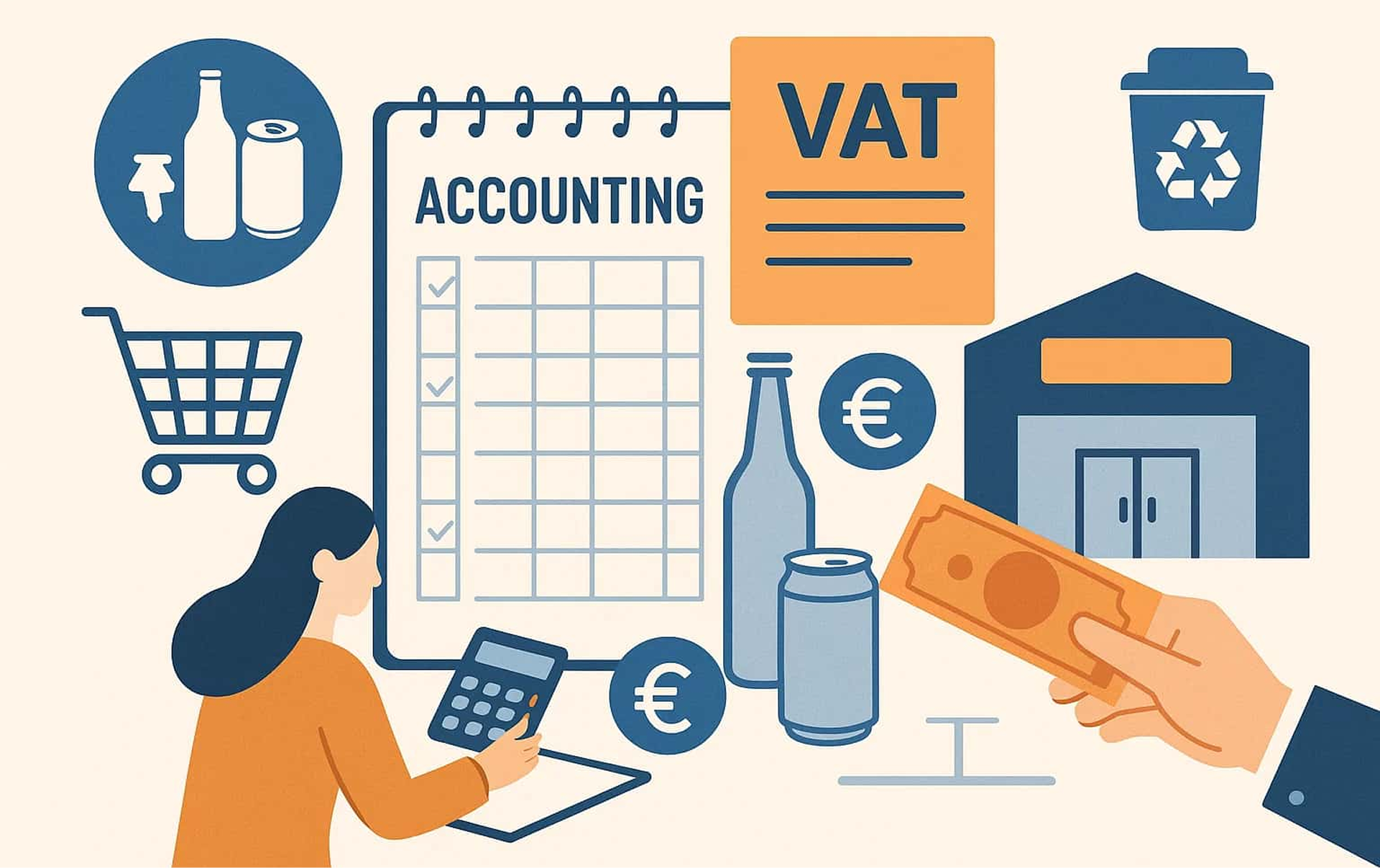
Reporting and Record-Keeping Obligations in the Deposit Return System
Entrepreneurs participating in the deposit return system are required to maintain detailed records of all operations related to collecting, refunding, and non-return of containers subject to deposits.
These records must enable identification of the number of containers placed on the market along with charged deposits, registration of returns made by consumers, and indication of the number of containers that were not returned. All this data is crucial for proper VAT settlement, particularly in the context of deposits constituting taxable income when containers do not return to circulation.
Companies are required to regularly report record data to the system operator and to relevant state authorities. Reports must reflect the actual state of returns and sales and serve transparency and effective control of the entire system. Failure to comply with record-keeping obligations or submitting incomplete or false information may result in administrative and tax sanctions. In practice, this means the need to adapt IT systems and accounting processes to precisely record every operation related to deposits and ensure the ability to easily prepare required reports.
VAT Settlements and Invoice Issuance in the Deposit Return System
In the deposit return system, invoice issuance is subject to special rules that entrepreneurs must consider to properly account for VAT. The deposit charged for the container should be separately shown on the invoice, which allows it to be clearly distinguished from the value of the beverage or other product itself. According to regulations, the deposit is not included in the VAT tax base in case of container return, therefore proper documentation of this fact with invoices or other sales documents is necessary.
Entrepreneurs are required to issue a VAT invoice covering the sale of the deposit at the buyer’s request or in cases provided by law. The invoice should contain all required elements, including seller and buyer data, issue date, invoice number, detailed transaction description, net value, rate, and VAT amount. When issuing invoices, it is also important to consider the moment of tax obligation arising, which in the case of deposits may occur upon sale or settlement of unreturned containers at year-end.
In practice, this means the need to introduce functions in sales and accounting systems that enable separation of deposit value and VAT amount, as well as reflection of deposit refunds on subsequent documents. Proper invoice issuance and VAT accounting in the deposit return system is not only a legal requirement, but also a way to avoid discrepancies during tax audits and optimize the company’s finances.
What VAT Rates and Exemptions May Apply to Deposits
In the deposit return system, deposits charged for beverage containers are not subject to VAT at the stage of collection and refund to the consumer—they are exempt from tax for both single-use and reusable containers. This means that the deposit is not included in the VAT tax base throughout the entire supply chain, from the producer or importer, through wholesalers, to retailers. However, when the container is not returned to the system, the deposit is treated as income and is subject to VAT under general rules, according to the VAT rate assigned to the product. For example, if the beverage is subject to a 5% rate, the unreturned deposit should be settled at the 5% rate; if it concerns a beverage subject to 23% VAT, that rate will apply to the non-refundable deposit.
It is worth emphasizing that the system does not cover containers not qualified for the deposit return system, where standard VAT rules apply. Therefore, companies must accurately distinguish containers introduced into the system to properly apply VAT rates and exemptions.
What Rate to Apply to Unreturned Deposits
In principle, the VAT rate for unreturned deposits should correspond to the VAT rate assigned to the beverage in the container (e.g., 5% or 23%). Situations may also arise where it will not be possible to assign a VAT rate to a returned container covered by the deposit return system. In such a situation, the taxpayer will account for unreturned containers or packaging waste using the proportion resulting from taxation of goods at different rates.
VAT settlement on unreturned deposits occurs once a year, in the declaration for the first period of the year following the year in which the difference between the number of introduced and returned containers was determined.
The introduction of the deposit return system is a significant change in market operations that requires entrepreneurs to take a conscious approach to VAT and precise accounting. Proper preparation and implementation of new procedures will certainly bring benefits and help avoid interpretive misunderstandings.





Contact us
We'll be happy to answer your questions - we know how to provide effective accounting services for companies.
Error: Contact form not found.
